Corrected Anion Gap for Hypoalbuminemia: How to Work It Out
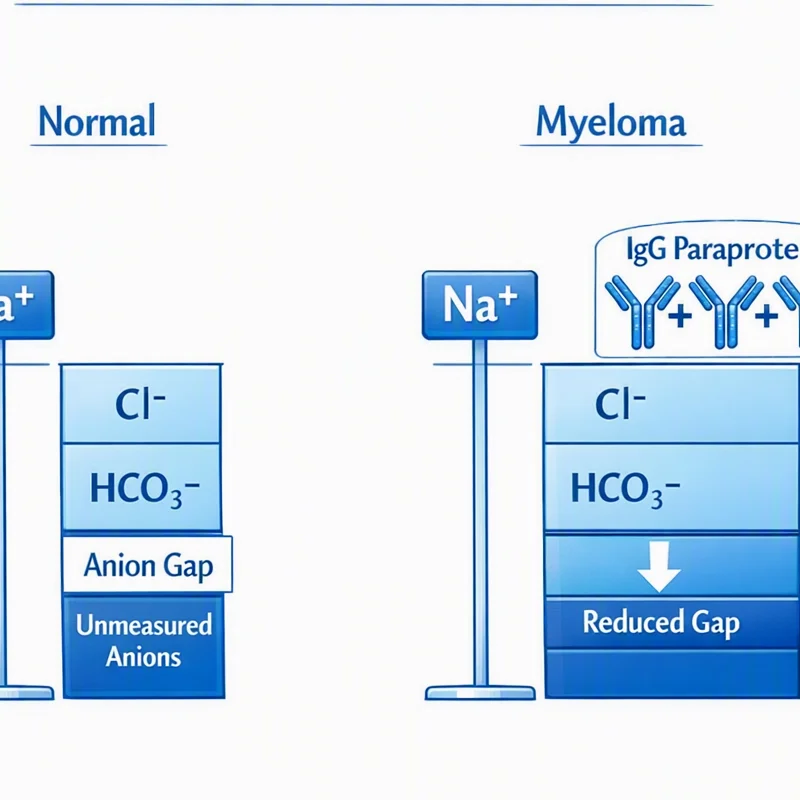
How is defined the anion gap?
The anion gap is a derived value used to assist evaluate an acid–base imbalance from a basic electrolyte lab panel. It compares with the main measured cations and anions in serum electrolytes, usually using sodium, chloride, and bicarbonate. In many cases, potassium may also be included, but the most common clinical formula focuses on sodium, chloride, and bicarbonate because potassium contributes less to routine interpretation.
A standard way to calculate the anion gap is:
Anion gap = Sodium - (Chloride + Bicarbonate)
This calculation helps identify whether there are unmeasured anions in the blood. A above-normal result can suggest metabolic acidosis, especially high anion gap metabolic acidosis, while a decreased value may reflect low albumin, laboratory variation, or other factors. Because the result is a derived number, the interpretation depends on the measured value, the normal range used by the laboratory, and the overall clinical assessment.
An anion gap calculator can simplify this process by setting out the formula and helping clinicians assess the electrolyte panel consistently. Still, the calculator is only a screening tool. The interpretation always depends on the full clinical picture, including serum bicarbonate, serum albumin concentration, and other laboratory values.
Why does hypoalbuminemia affect the anion gap?
Albumin levels is the key unmeasured negative ion in plasma. It has a negative charge, so when albumin decreases, the measured anion gap often drops too. This is why hypoalbuminemia can hide a clinically important metabolic disturbance. A patient may appear to have a standard or only mildly elevated anion gap even when acid accumulation is present.
The mechanism is clear: less albumin means fewer negatively charged proteins contributing to the gap. Because the body must keep acid-base balance, other ions move to maintain electrical neutrality. The result is that the measured anion gap can downplay the true burden of unmeasured acids.
This matters most in patients with low albumin, because a normal anion gap does not always mean normal acid-base interpretation. In fact, hypoalbuminemia can mask high anion gap metabolic acidosis. That is why the albumin-adjusted approach improves diagnostic accuracy and helps clinicians avoid failing to detect a serious condition.
In practical terms, the decreasing the albumin level, the more likely the measured gap will be lower. The correction is intended to restore a more realistic estimate of the patient’s acid-base balance by accounting for the missing negative charge from albumin.
How do you correct the anion gap for low albumin?
The albumin-adjusted anion gap uses a correction formula that amends the measured anion gap for the patient’s serum albumin. The purpose is to approximate what the anion gap would be if albumin were in the normal range.
Corrected anion gap = Measured anion gap + 2.5 mEq/L for each 1 g/dL albumin below normal
In other words, the albumin correction factor is commonly applied as 2.5 mEq/L per 1 g/dL albumin below the reference range. Many clinicians use an anion gap calculator to speed the calculation and decrease error, especially when multiple laboratory values must be reviewed quickly.
Here is the simple calculation logic:
- Initially, calculate the measured anion gap from sodium, chloride, and bicarbonate.
- Then, determine the serum albumin concentration.
- Assess the albumin level with the laboratory reference range.
- Apply the correction formula using 2.5 mEq/L per 1 g/dL albumin below normal.
- Evaluate the corrected anion gap in the context of the patient’s clinical context.
This is especially helpful useful when assessing metabolic acidosis because the corrected value can uncover a high anion gap that the measured value may have missed. The process enhances interpretation and supports more accurate clinical assessment.
For example, if the measured anion gap is normal but the albumin is low, the albumin-adjusted anion gap may actually be elevated. That change can alter diagnosis, management, and urgency.
What is the albumin correction coefficient in 2026?
In 2026, the most widely used albumin correction factor remains 2.5 mEq/L per 1 g/dL albumin. This value is often used because it provides a practical and clinically useful adjustment for laboratory interpretation.
The usual reference range for albumin can vary between laboratories, but many sources use approximately 4.0 g/dL as a reference point for correction. If a patient’s serum albumin concentration is below that reference range, the corrected anion gap is adjusted upward by the amount expected to offset the lost negative charge.
A sample correction approach is:
Corrected anion gap = Measured anion gap + 2.5 × (4.0 - serum albumin in g/dL)
This albumin correction is not perfect, but it is a valuable clinical approximation. It improves laboratory interpretation, especially when the goal is to identify hidden high anion gap metabolic acidosis. For that reason, the correction coefficient remains useful as a practical standard in 2026.
Different institutions may use somewhat different formulas or thresholds, so clinicians should always consider local reference range policies. Even so, the core principle remains the same: low albumin reduces the measured anion gap, and correction enhances acid-base interpretation.
When should you calculate a corrected anion gap?
You should work out a corrected anion gap whenever hypoalbuminemia is present and acid-base interpretation is clinically relevant. This is especially useful in metabolic acidosis, where a normal measured anion gap may be misleading.
Common situations include:
- Suspected increased anion gap metabolic acidosis
- Critical illness with low albumin
- Renal failure with possible retained acids
- Unexplained changes in serum bicarbonate
- Mixed acid-base disorder patterns
Critical illness often involves inflammation, malnutrition, fluid shifts, and reduced albumin synthesis, all of which can lower albumin. In those settings, relying only on the measured value may minimize the severity of the metabolic disturbance. The albumin-adjusted result can provide a more reliable screening tool for hidden acid accumulation.
Renal failure is another important example because reduced acid clearance can increase the anion gap. If albumin is low at the same time, the measured value may look less abnormal than it truly is. In such cases, a corrected anion gap can improve diagnostic accuracy and support further evaluation.
In general, the more abnormal the serum electrolytes and albumin are, the more helpful the correction becomes. That does not mean every patient needs the calculation, but it is especially helpful when the clinical context suggests a significant metabolic disturbance.
What are the constraints of the corrected anion gap?
The corrected anion gap is useful, but it is not conclusive. One limitation is laboratory variation. Different analyzers, assay methods, and reporting conventions can affect sodium, chloride, bicarbonate, and albumin values. Small shifts in laboratory values may change the calculated result.
Another limitation is that mixed acid-base disorders can complicate interpretation. For example, a patient may have metabolic acidosis and metabolic alkalosis at the same time. In that case, the anion gap alone may not fully capture the underlying physiology. The corrected anion gap helps, but it should not take the place of full clinical assessment.
Albumin level also matters because the formula assumes a standard relationship between albumin and the gap. That relationship may not hold perfectly in every patient. Severe illness, paraproteinemia, unmeasured ions, and unusual electrolyte patterns can all affect the final interpretation.
For that reason, clinicians should interpret the result in clinical context rather than treating the corrected number as absolute. The correction improves the estimate, but it does not remove uncertainty. The best use of the calculation is as part of a broader evaluation that includes symptoms, acid-base status, and the rest of the electrolyte panel.
In short, the corrected anion gap is most helpful when used thoughtfully. It increases confidence, but it cannot replace bedside judgment, trend review, and attention to the patient’s overall condition.
Illustrations of corrected anion gap calculations
Example calculations make the concept simpler to apply. Presented below are practical illustrations using a measured anion gap, albumin in g/dL, and the standard correction factor.
Example 1:
Measured anion gap = 10 mEq/L
Serum albumin concentration = 2.0 g/dL
Assuming a reference point of 4.0 g/dL, the albumin deficit is 2.0 g/dL.
Correction = 2.5 × 2.0 = 5.0 mEq/L
Corrected anion gap = 15 mEq/L
Meaning: The measured value looked normal, but the corrected anion gap indicates a possible high anion gap process. This is a classic example of how low albumin can hide metabolic acidosis.
Example 2:
Measured anion gap = 16 mEq/L
Serum albumin concentration = 3.0 g/dL
Albumin deficit = 1.0 g/dL
Correction = 2.5 × 1.0 = 2.5 mEq/L
Corrected anion gap = 18.5 mEq/L
Meaning: The corrected value is clearly elevated and supports evaluation for high anion gap metabolic acidosis.
Example 3:
Measured anion gap = 8 mEq/L
Serum albumin concentration = 1.5 g/dL
Albumin deficit = 2.5 g/dL
Correction = 2.5 × 2.5 = 6.25 mEq/L
Corrected anion gap = 14.25 mEq/L
Clinical note: This result shifts from low-normal to potentially abnormal once hypoalbuminemia is accounted for. That change can materially affect diagnosis and management.
This highlights why an anion gap calculator can be so helpful in daily practice. It turns a quick formula into a reliable step in interpretation, especially when multiple laboratory values must be reviewed together.
Common questions on anion gap correction in low albumin
What’s the corrected anion gap in hypoalbuminemia?
The adjusted anion gap in hypoalbuminemia is the measured anion gap adjusted upward to account for low albumin. Because albumin carries negative charge, low albumin can make the measured value seem lower than it is. The corrected result gives a better estimate of the true acid-base status.
How is anion gap correction for albumin?
First find the measured anion gap from sodium, chloride, and bicarbonate. Then apply 2.5 mEq/L for each 1 g/dL of albumin below the usual reference level, often 4.0 g/dL. This correction formula is commonly used to produce an adjusted anion gap.
Why does low albumin lower the measured anion gap?
Low albumin lowers the measured anion gap because albumin is a key unmeasured anion in serum. When albumin decreases, fewer negative charges are present, so the gap narrows. This can underestimate metabolic acidosis unless the value is corrected.
What is the correction factor for albumin in 2026?
The most common albumin correction factor in 2026 is 2.5 https://anion-gap-review672.lumenforgex.com/posts/anion-gap-calculator-with-serum-chloride mEq/L per 1 g/dL albumin below normal. This factor is commonly applied for laboratory interpretation, although local reference range practices may vary.
When does a corrected anion gap more useful than the measured anion gap?
A corrected anion gap is more useful when hypoalbuminemia is present, especially in metabolic acidosis, high anion gap metabolic acidosis, critical illness, renal failure, or any possible mixed acid-base disorder. In those settings, the measured value may underestimate the real abnormality, while the corrected result improves interpretation and clinical assessment.